


Subscribe for NMSafety News
Anti Static Glove with HPPE & Glassfiber for Sharp Edges
12 Jan, 2026
By hqt

When sharp edges and static risks share the same production line, your glove can’t force trade-offs. Anti Static Glove performance becomes the hinge between worker safety and product integrity, and SRSafety builds that hinge to hold. Our approach is simple: deliver reliable cut protection, dependable ESD control, and firm grip in wet and oily conditions – without sacrificing comfort or dexterity.
Why a Single Anti Static Glove Matters
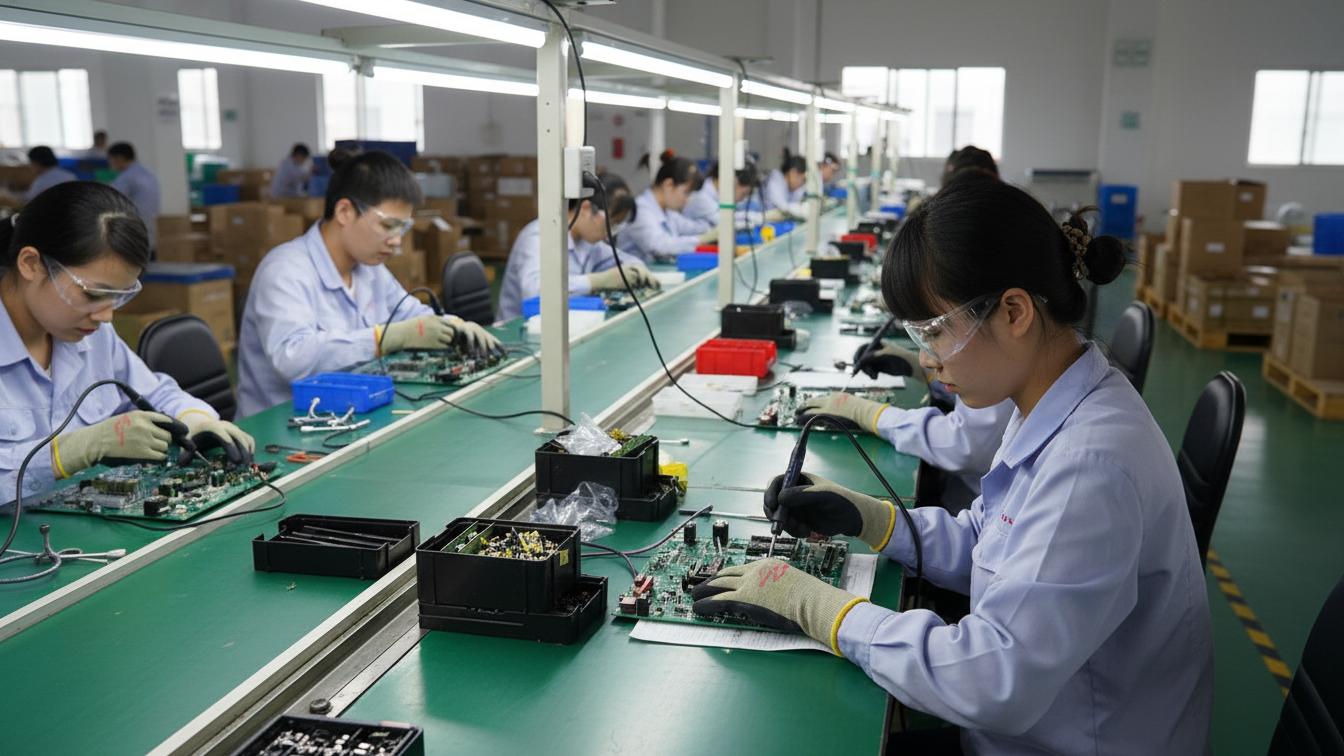
Walk any modern plant and you’ll see operators moving from stamped metal to PCB assemblies, from fasteners to sensors, from oily gearboxes to test stations. A glove that’s strong near burrs but weak at dissipating charge is a liability. So is a glove that drains static but loses traction on a greasy surface. The result of switching back and forth? Missed steps, noncompliance, and elevated risk. A well-designed Anti Static Glove removes that friction by doing both jobs, all shift long.
- The Dual Risk You Need to Control
– Sharp edges drive lacerations, rework, and downtime. They also erode confidence – once someone gets cut, they work slower and with less precision.
– ESD damage is often invisible, surfacing later as intermittent failures, returns, and warranty claims. A single discharge can compromise a board and go undetected until your customer finds it.
Traditional cut-resistant gloves aren’t always engineered for safe static dissipation. Conventional ESD gloves often trade away cut protection, or they lose grip in wet and oily zones. SRSafety’s Anti Static Glove with HPPE and glass fiber was developed specifically for environments where both hazards are present, and where teams can’t afford to compromise.
Performance Anchored by Recognized Standards
Selection should be transparent. Our Anti Static Glove targets a balanced cut profile – ANSI A3 and ISO 13997 Level C – suited to assembly, maintenance, and handling tasks that involve repeated contact with sharp metal while still demanding dexterity. On the ESD side, the glove is constructed to continuously dissipate charge, supporting disciplined control programs that shield both worker and product from transient static events. The bottom line: predictable cut resistance, consistent conductivity, and responsive finger feel.
- Engineering that Starts With Materials
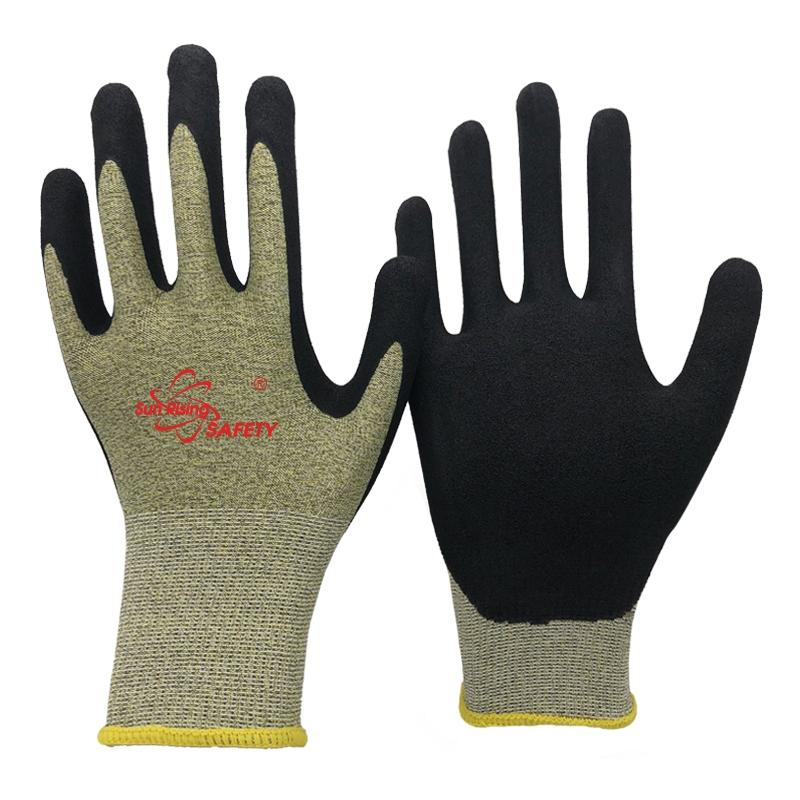
Every component in an SRSafety glove earns its place. The 18-gauge knitted liner blends nylon, carbon fiber, HPPE, and glass fiber. Together, they create a strong, thin, breathable platform.
– Nylon keeps the glove light and airy, reducing heat buildup over long shifts.
– Carbon filaments deliver reliable ESD decay and fingertip response on capacitive devices.
– HPPE and glass fiber reinforce the knit to resist cuts and abrasion around burrs and sheared edges.
– Textured nitrile (sandy) palm maintains high traction and durability across dry, wet, and oil-exposed tasks.
This recipe delivers a protective and precise Anti Static Glove. The 18-gauge construction preserves tactile feedback for handling small fasteners, connectors, and instruments. Operators can navigate tight clearances without removing their gloves to regain feel, and they can interact with touchscreens without breaking ESD discipline or pausing their workflow.
Grip, Dexterity, and Comfort that Workers Actually Use
Grip is not an accessory – it’s a safety feature. In wet and oily cells, the sandy nitrile texture engages the surface, displacing fluids and creating confident contact. That stability reduces micro-slips and helps maintain alignment during tightening, placement, and inspection tasks. Comfort is equally critical. If a glove runs hot or feels restrictive, operators won’t wear it consistently. Thanks to its airy nylon foundation, close-knit gauge, and adaptive coating, hands track naturally, fatigue stays low, and pace stays high. Balancing cut resilience with fingertip feel helps crews work safely and efficiently.
✅ Practical Settings for an Anti Static Glove
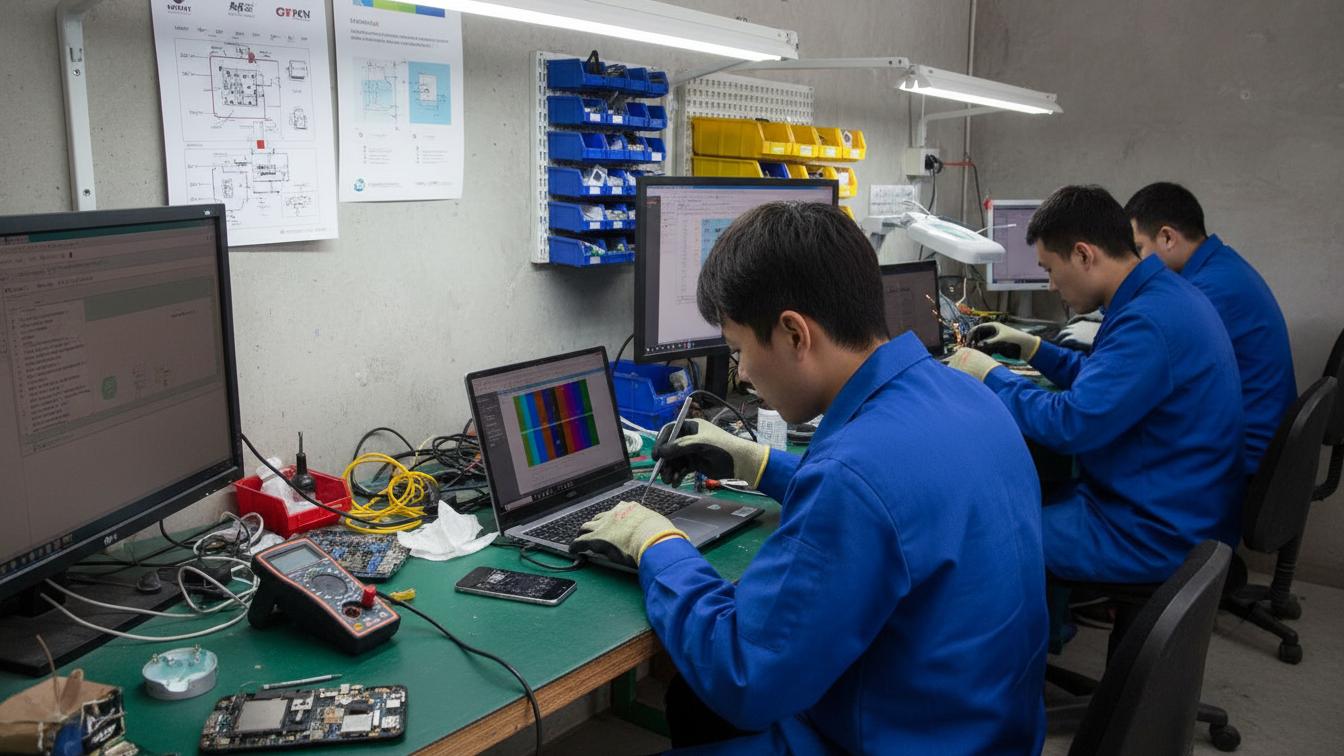
• PCB lines and test labs with continuous ESD controls and fine-placement requirements.
• Automotive assembly where sheet metal, fluids, connectors, and sensors converge on the same shift.
• Aerospace harness and component assembly needing clean contact, cut resilience, and charge dissipation.
• Maintenance crews in mixed-manufacturing plants, adapting to changing risks as jobs switch over.
Workers see fewer replacements, improved PPE follow-through, and stable protection. The wide size curve – XS to 3XL – serves varied workforces, preventing excess material or compression. A well-fitting Anti Static Glove is worn more often and for longer, which directly reduces avoidable incidents and improves ESD program adherence.
Deployment with a Partner Who Understands Operations
A glove can be beautifully designed and still stumble if it doesn’t fit the task. SRSafety works side by side with your teams to integrate the right Anti Static Glove into your process. We start with risk assessment, build training around your workflows, and measure adoption to identify opportunities for improvement.
- Facility-Specific Configuration
Branding and line-of-sight management: custom logos, color standards, and pack labeling for clearer inventory control.
ESD ecosystem guidance: pair gloves with coats, mats, heel/toe straps, monitors, and documented workflows.
Sizing and fit audits: structured wear tests to improve user buy-in and fine-tune your size curve.
Planning deliveries around your build schedule keeps your lines running smoothly. Typical lead times range from 60 to 120 days based on configuration and order volume. Early coordination prevents last-minute substitutions that weaken ESD and cut strategies.
✅ Care Guide at a Glance
• Check before each use and remove any glove with damage or peeling.
• Clean per manufacturer guidance to sustain ESD performance and reliable grip.
• Integrate gloves into workstation ESD verification; perform quick continuity tests.
• Keep stored in a dry, cool spot, away from sharp edges that can nick the liner or coat.
These small steps help preserve both cut protection and static control, so your glove performs like new for longer.
- A Straightforward Call to Action
If your teams work near sharp metal and sensitive electronics, they deserve a glove that doesn‘t force trade-offs. Request a sample and a short application review with SRSafety. Our specialists will map your tasks, identify hazards, and recommend the Anti Static Glove configuration that fits your line, your operators, and your ESD program. Contact us to schedule a demo, discuss customization, and align deliveries with your production plan.
Why SRSafety for Your Anti Static Glove
Our philosophy is to engineer for real work. The combination of 18-gauge nylon, carbon fiber, HPPE, glass fiber, and a sandy nitrile palm isn’t arbitrary – it’s a materials system tuned to solve recurring pain points in manufacturing. With ANSI A3 and ISO 13997 Level C cut resistance, consistent static dissipation, firm grip in wet and oily conditions, and comfort built for long shifts, this Anti Static Glove helps protect your people and your product while keeping throughput high.
In a world where sharp edges and ESD risks share the same space, you don’t need a compromise. You need a glove that balances protection with performance and makes compliance the easy choice. That’s what SRSafety delivers: engineered safety, fit for the job, ready for the realities of modern production.
