Home > BLOG > Choosing ECO Friendly Gloves: Ethics vs. Expenses?
Choosing ECO Friendly Gloves: Ethics vs. Expenses?
13 Aug, 2025
By hqt
ECO Friendly Gloves are no longer a side-topic in procurement meetings – they are at the center of every discussion about cost control, compliance, and corporate responsibility. As a manufacturer that has produced safety work gloves for global partners since 2006, SRSafety has witnessed the shift firsthand. Below we share our view on the real trade-offs, the hidden pain points, and why our latest RPET winter model may help you answer the classic question: Cost or Conscience?
Why Industries Still Hesitate to Embrace ECO Friendly Gloves
• Operational Anxiety: “Will Performance Suffer?“
Site managers tell us their greatest fear is abrupt downtime caused by torn or slippery gloves. Traditional PVC styles feel “safe” because they are familiar, but they often crack in cold yards or lose grip in oily bays. Decision-makers worry that greener alternatives may magnify those issues.
• Budget Pressure: “Green Means Expensive“
Another pain point is budget predictability. Annual safety gear budgets are planned months ahead; any premium price tag is scrutinized. Finance teams therefore question whether ECO Friendly Gloves are “just another cost center” with unclear ROI.
• Uncertain Compliance: “Are They Really Sustainable?“
Many gloves claim to be eco-friendly. Without transparent sourcing, EHS leaders struggle to defend the purchase in audits. If the supply chain or recycling claims look weak, procurement stalls.
How SRSafety Gains Trust with Eco-Friendly Gloves
• The RPET Advantage in a Single Shell
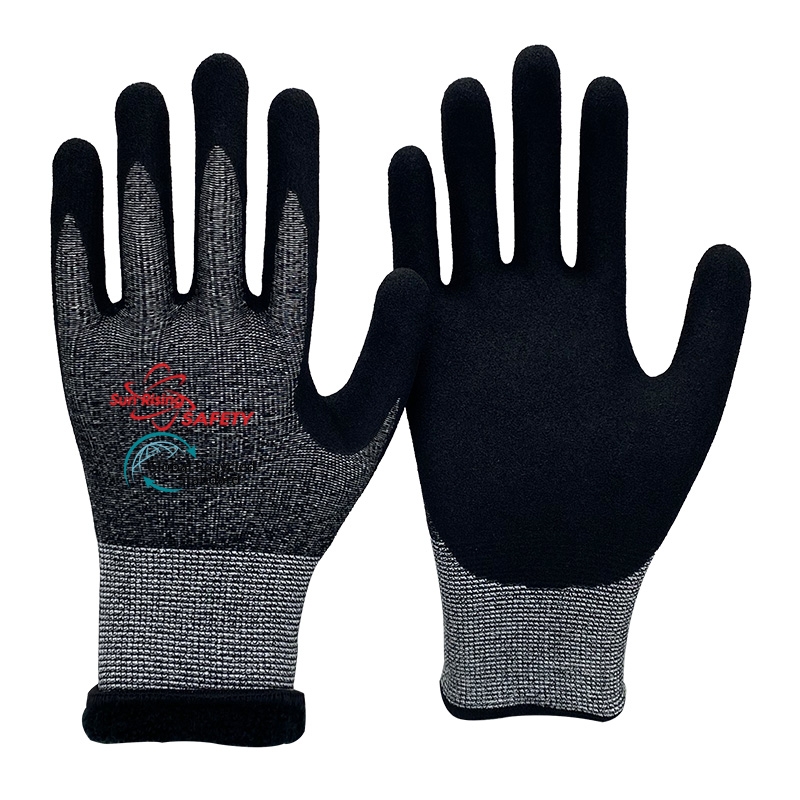
Our Eco-friendly Thermal RPET Polyester & Terry Acrylic Winter Glove starts with yarn spun from recycled PET bottles. The 13-gauge outer shell matches virgin polyester for tensile strength yet removes virgin plastic from your supply chain. Inside, a plush 7-gauge terry acrylic lining traps warm air, so hands remain nimble on freezing scaffolds and loading docks.
✅Durability Without the Weight – Sandy nitrile coating resists abrasion and puncture on sheet-metal edges.
✅Confident Wet-Oil Grip – Micro-texture channels fluids away, maintaining hold on hydraulic tools.
✅Genuine Sustainability – RPET fiber certification plus in-house traceability audits for every batch.
Many partners assume any eco upgrade carries a steep premium. Our vertical footprint – 400 knitting machines and five automated dipping lines – lets us manage costs in-house. Fewer blow-outs mean fewer emergency re-orders, so season-long spending often reaches parity without rebates or subsidies. In most pilot programs, teams hit break-even by the third reorder cycle simply through reduced waste and downtime, not creative accounting.
• Turning Skeptics into Advocates – Fast
We understand that plant managers judge gloves on output, not ideology. That’s why each shipment arrives with a one-page usage log: supervisors record swap intervals, grip complaints, and liner failures. After a month, most plants see:
Those real-world metrics turn sustainability from a marketing slogan into an operational gain.
• Ready for Multiple Sectors
Manufacturing, forestry, agriculture, construction, and heavy automotive lines have all field-tested this style. The same glove that protects pruning crews in damp orchards keeps diesel mechanics steady on oil-splashed engines. That cross-industry flexibility matters when you negotiate bulk contracts – one SKU, many roles, zero last-minute substitutions.
• Beyond the Glove: Service That Counts
✅Rapid Customization – Add color-coded cuffs for task zoning or print batch IDs for audit trails.
✅Global Certifications – CE, ANSI, ISO docs ship with each pallet, easing border inspections.
✅Strategic Inventory Support – Quarterly demand planning locks in production slots, shielding you from surge pricing.
Cost or Conscience?
Switching to ECO Friendly Gloves is not a leap of faith; it is a structured transition that balances finance, safety, and sustainability targets.
• Start with a Pilot Lot– Request samples sized S-3XL. Let supervisors record tear-down time and worker feedback.
• Compare Failure Rates– Track discarded pairs across two pay periods. Lower turnover frequently surprises budget owners.
• Leverage Brand Credibility – Display the RPET story on internal dashboards and CSR reports. Auditors value data-backed claims.
• Negotiate Volume-Based Pricing – Our MOQ is aligned with mid-scale rollouts, and lead times fit seasonal planning.
Call-to-Action: Ready to prove that “green” can also mean “profitable”? Email our solutions team at sales@srsafety.cn or click the chat icon on this page to schedule your no-obligation pilot shipment. Let us help your plant answer the Cost-or-Conscience debate once and for all.
Final Thought
Adopting ECO Friendly Gloves is not merely a marketing gesture. For forward-thinking companies it is an operational choice that secures worker safety, trims hidden waste, and strengthens brand equity. SRSafety stands ready to guide you from trial to full deployment – because conscience should never be a cost you cannot justify.